Enterprise Internal Platform
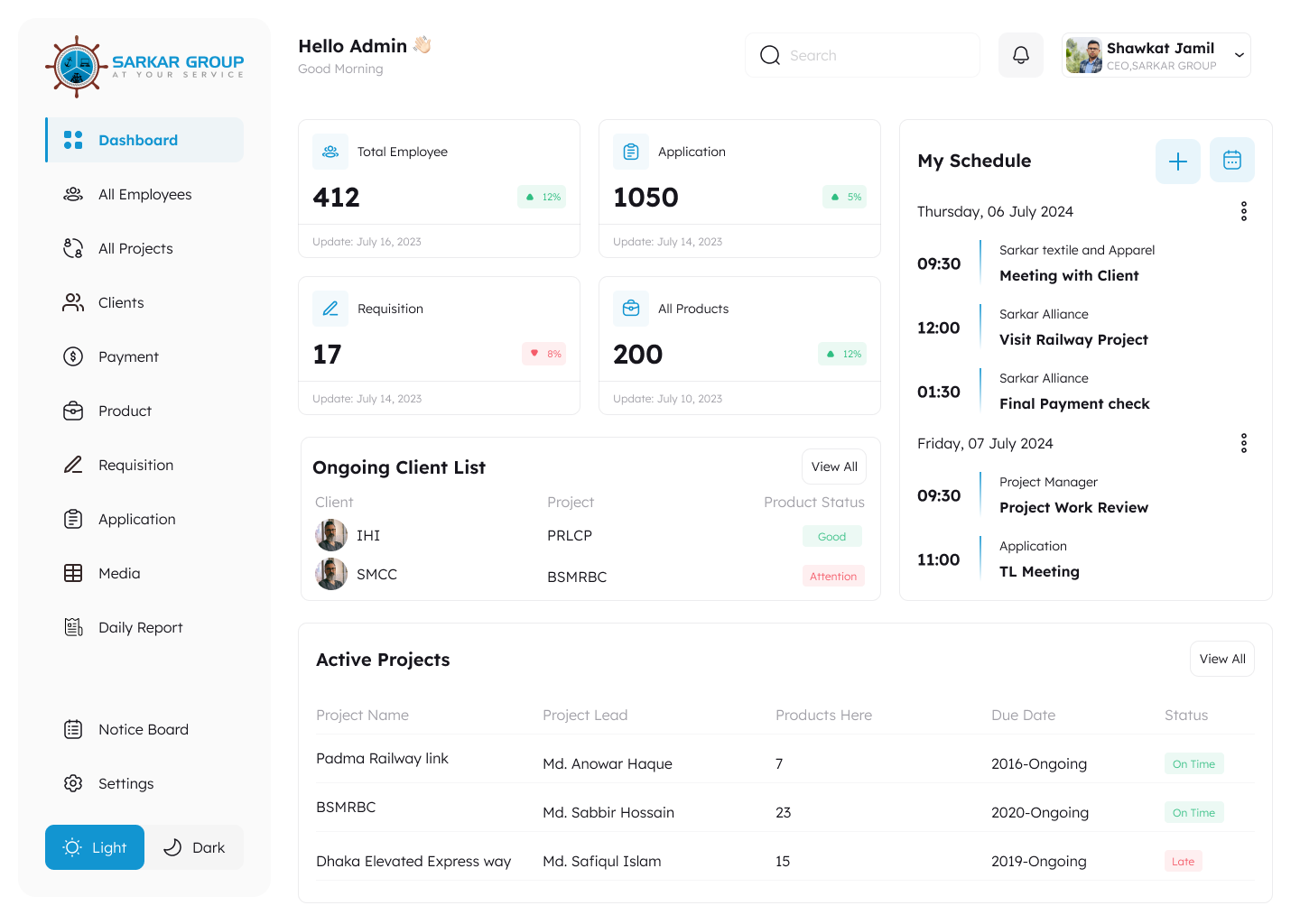
Sarkar Group SMD modernizes operations for a 1000-employee construction and marine engineering firm. It replaces disconnected manual processes (email approvals, spreadsheet equipment tracking, paper HR forms) with a unified, role-scoped platform that every employee can use confidently.
// screenshots
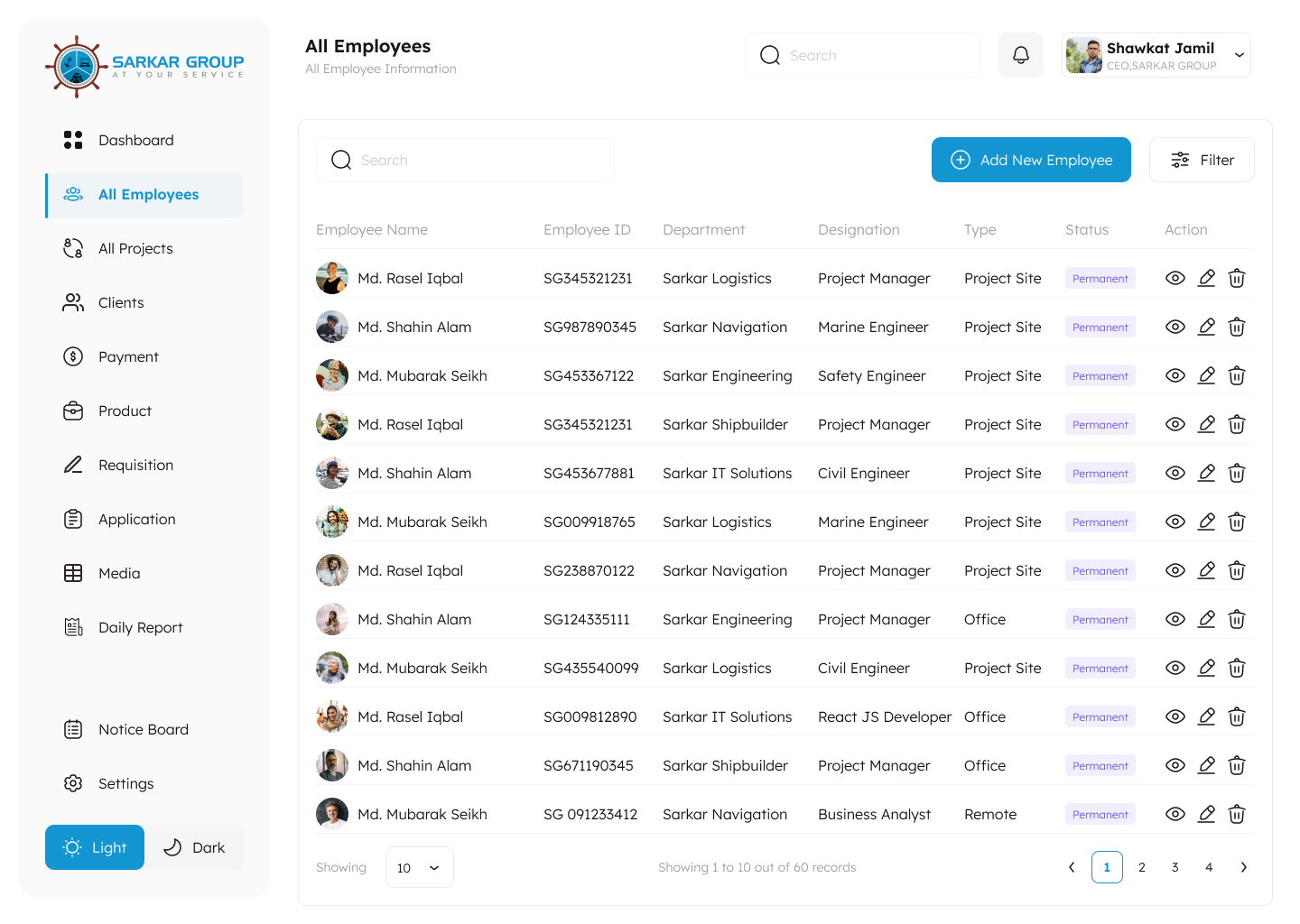
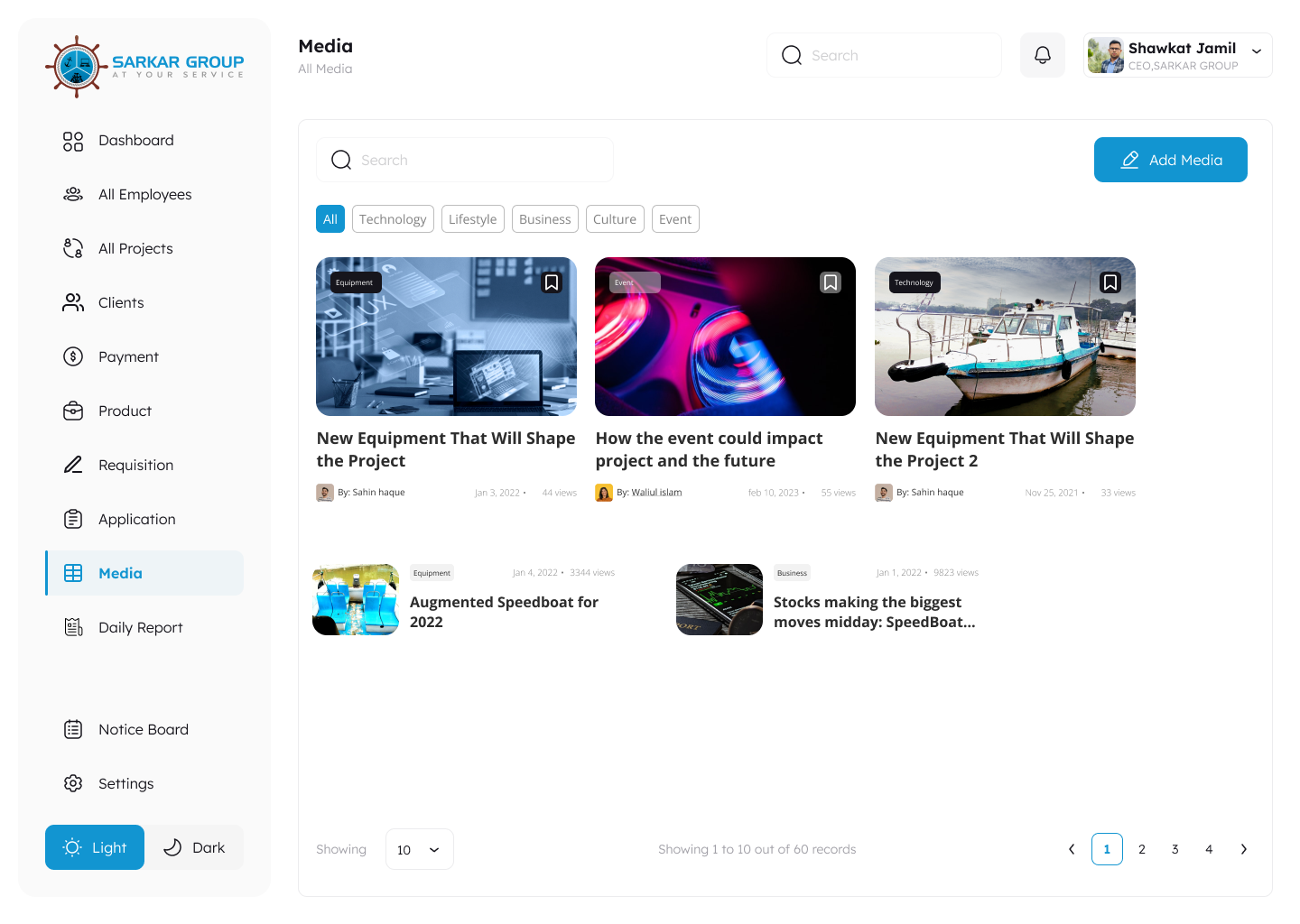
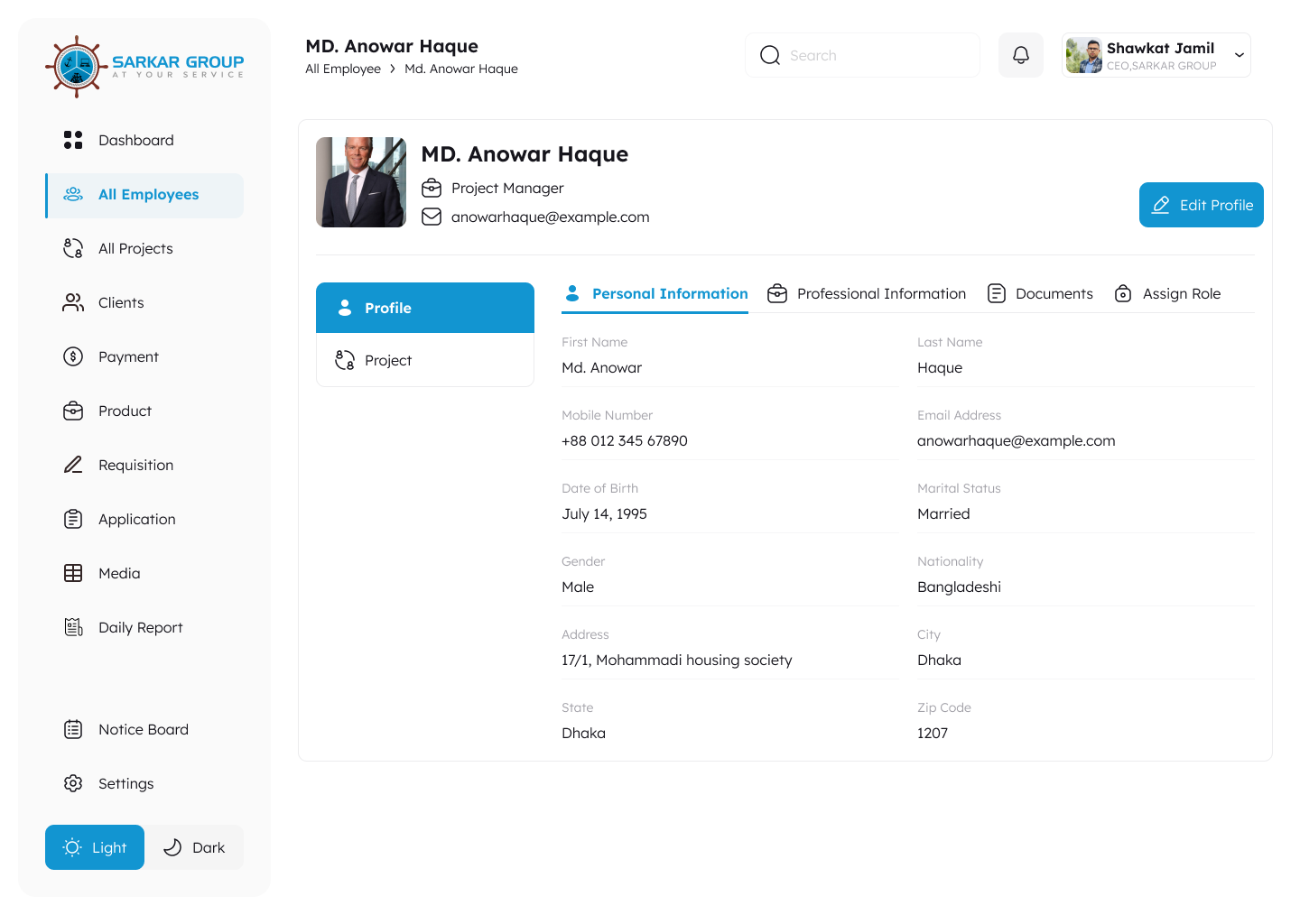
// overview
vision
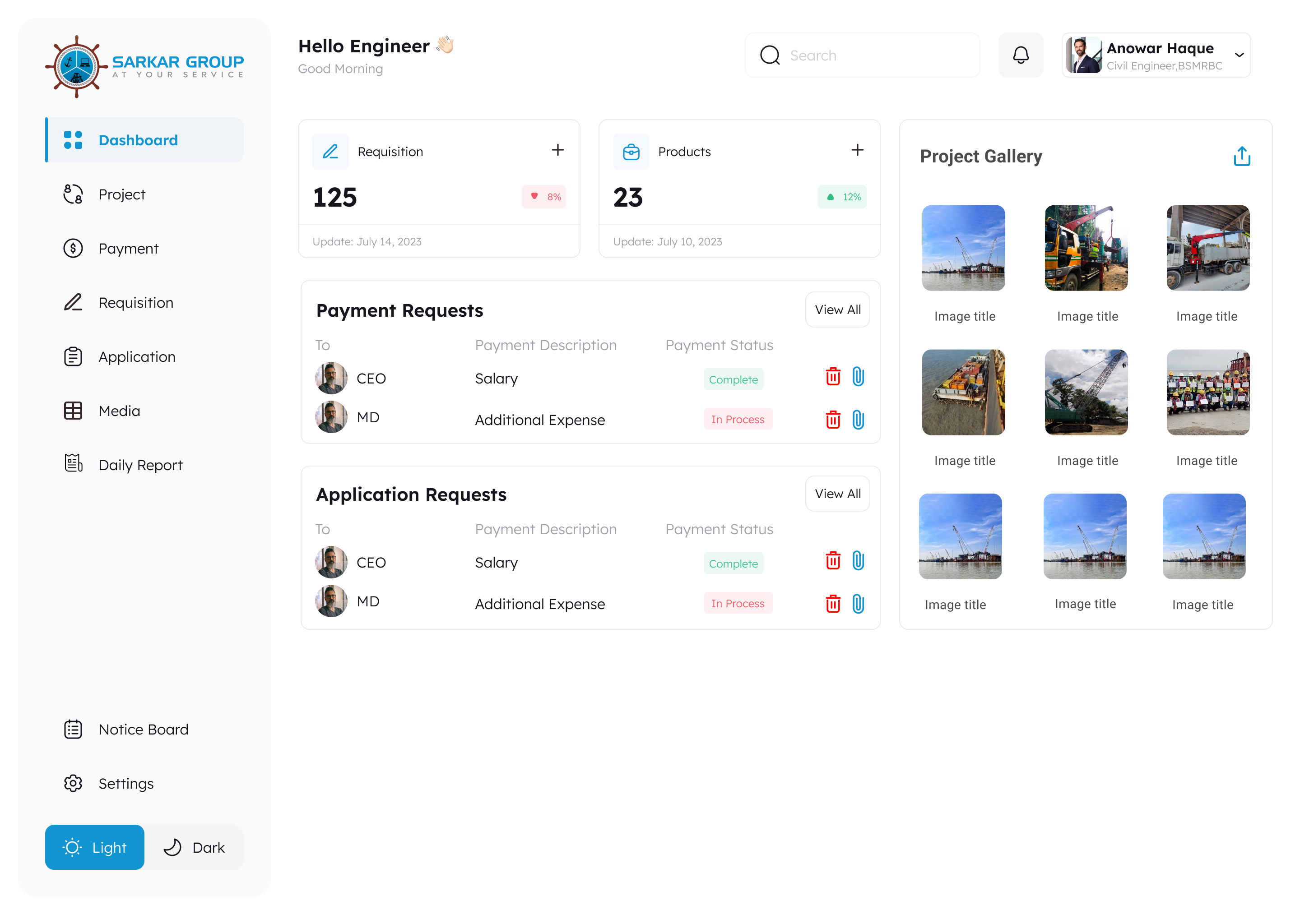
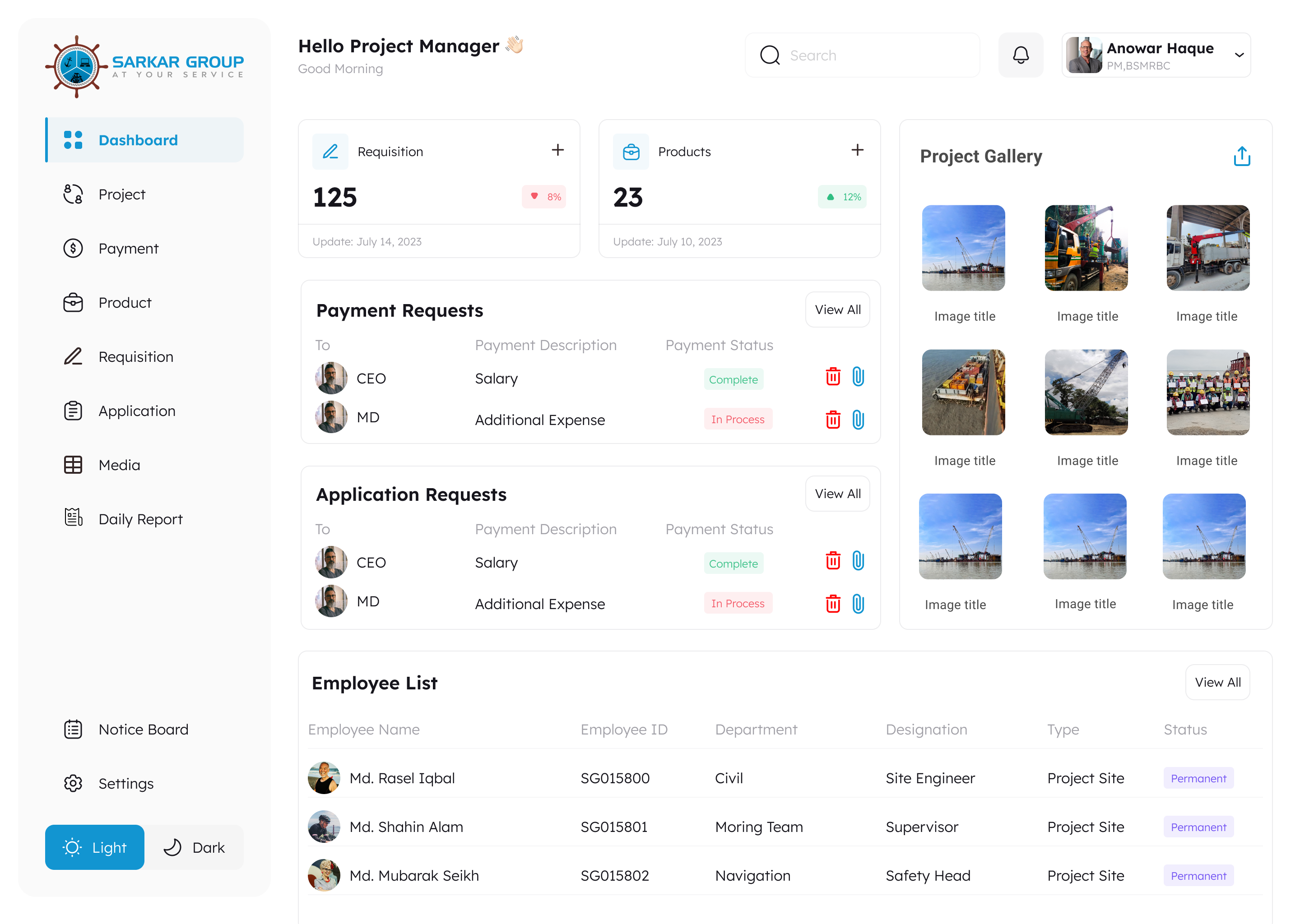
Replace fragmented manual workflows with a single, permission-driven platform that every role can trust — from CEO approving requisitions to engineers submitting leave and uploading site photos.
audience
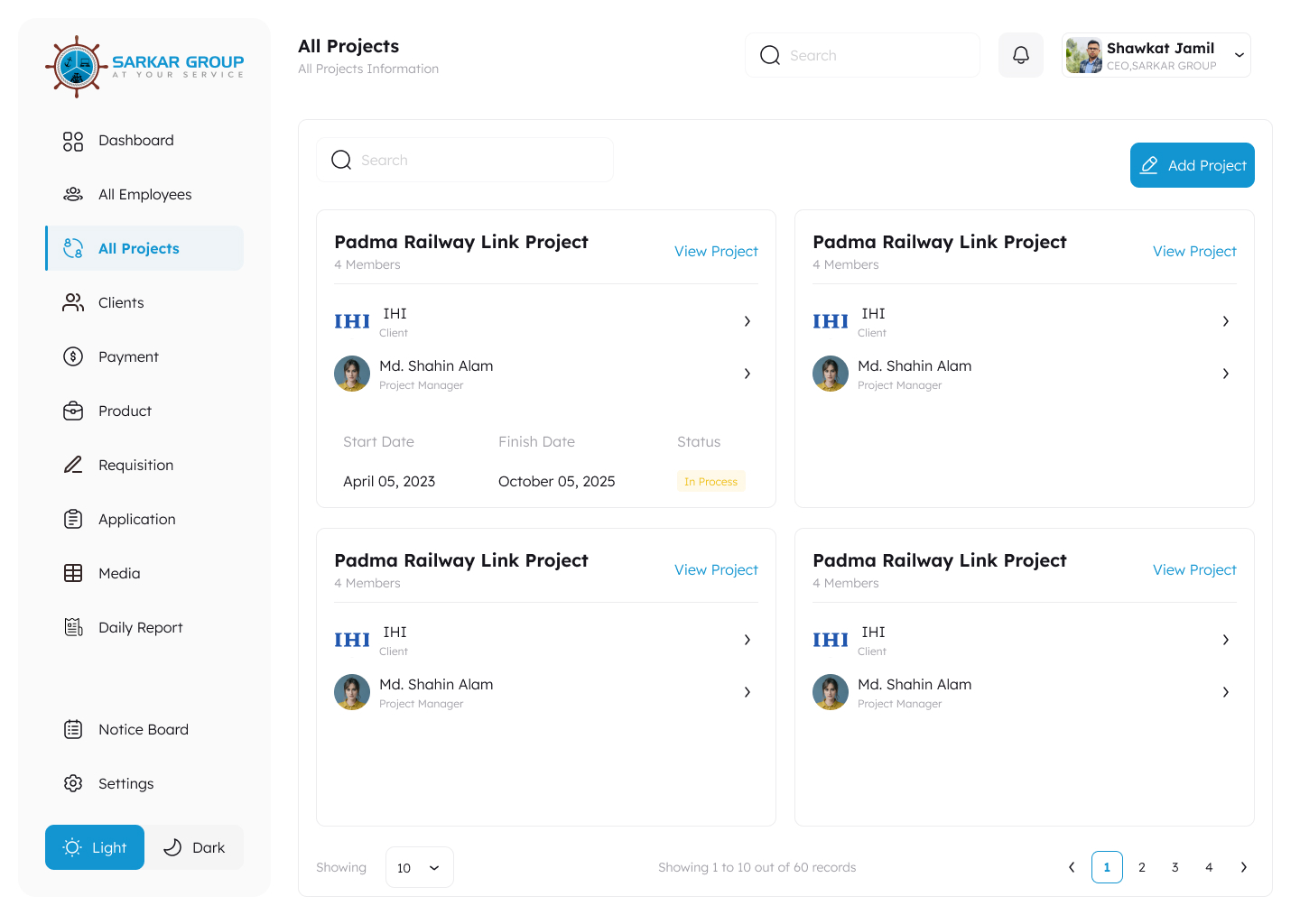
1000+ internal company staff: HR admins, department heads, project managers, engineers, field crews, and clients — each with a purpose-built dashboard.
outcome
Production-live system active for day-to-day operations. 15+ API modules, 20+ database models, 5 role dashboards, real-time SSE notifications, and Dockerized deployment on Vercel + MongoDB Atlas.
// problem
The company managed operations through disconnected processes: equipment tracked in spreadsheets, financial approvals via email chains, HR forms submitted on paper, project updates via messaging threads. Core challenges: (1) Enforcing strict role-based permissions without duplicating authorization logic; (2) Tracking complex equipment lifecycle with request/approval flows; (3) Running 3 parallel approval workflows (payments, requisitions, equipment) each needing document upload, multi-level approval, and decline tracking; (4) Supporting 8 distinct HR application types with audit trails; (5) Delivering real-time feedback on approvals without WebSocket infrastructure; (6) Building 15+ API modules without query code duplication.
// solution
Designed the entire platform with separation of concerns: Express backend with JWT auth, role-array authGuard middleware on every route, and a generic PrismaQueryBuilder class serving all 15+ modules. A singleton NotificationService maintains a Map<userId, Set<Response>> for all SSE connections, broadcasts on workflow submissions, and sends targeted notifications on approval/rejection. Role-specific dashboards use Prisma $transaction to run 10-15 parallel aggregation queries in a single round trip. Frontend uses Next.js 16 with role-gated route groups, Redux Toolkit state management, MUI + TailwindCSS UI, and TipTap for rich editing.
// my_role
Full-Stack Architect & Solo Developer
- › Designed full MongoDB schema: 20+ Prisma models, enums, relations, and join tables
- › Built generic PrismaQueryBuilder — chainable class with .search/.filter/.sort/.paginate/.includeRelations reused across all modules
- › Implemented JWT auth: sign/verify/decode/blacklist Token utilities, authGuard middleware, sseAuthGuard for SSE routes
- › Architected and implemented 15+ API modules covering every business domain
- › Built singleton NotificationService: SSE registry, broadcast-to-roles, targeted send, keepalive pings, lifecycle cleanup
- › Designed dashboard aggregation: Prisma $transaction with 10-15 parallel queries and month-over-month deltas
- › Implemented equipment assignment validation chain: reusable across request approval and project operations
- › Built structured Rocket server class (load/initiate/launch) with modular routing and global error handling
- › Set up Next.js with role-gated route groups, Redux Toolkit + redux-persist, next-auth sessions
// tech_stack
backend
TypeScript, Express.js, Prisma ORM, MongoDB, JWT, Zod, Bcrypt, Nodemailer, Multer, CORS, cookie-parser
frontend
Next.js 16 (App Router), React 18, Redux Toolkit, redux-persist, next-auth, MUI v6, TailwindCSS, Lucide React, Sonner, react-hook-form
realtime
Server-Sent Events (SSE), Express res.write(), singleton NotificationService
richContent
TipTap (rich editor), react-pdf, pdfjs-dist
storage
Cloudinary (profile images, documents, media), Multer (uploads)
infrastructure
Docker, Docker Compose, Vercel, MongoDB Atlas, dumb-init
// key_features
- › 5 isolated role dashboards with complete permission scoping
- › Project lifecycle management: assignment, equipment linking, status tracking, client visibility
- › Equipment registry with status lifecycle (WORKING/RUNNING/STAND_BY/BREAK_DOWN) and crew assignment
- › Equipment request workflow: request → admin approval → auto-assignment
- › 3 parallel financial workflows: payments, requisitions, equipment requests — all with document upload, multi-level approval, and decline reasons
- › 8 HR application types: leave, resignation, transfer, salary advance, loan, complaint, grievance, expense
- › Server-Sent Events (SSE) real-time push notifications to all relevant stakeholders
- › Rich media system with TipTap editor, image uploads, keyword tagging, and comment threads
- › Role-specific dashboards with KPI aggregations and month-over-month deltas
// contributions
- › Designed 20+ Prisma models with complex relations, enum-driven status fields, and atomic $transaction blocks
- › Built PrismaQueryBuilder — generic chainable class eliminating query duplication across 15+ modules
- › Implemented JWT auth with blacklist, authGuard middleware, and sseAuthGuard for streaming
- › Built NotificationService: SSE client registry, broadcast-to-roles, targeted send, keepalive, cleanup
- › Designed dashboard endpoints: Prisma $transaction with parallel aggregation, KPI deltas, trend indicators
- › Implemented equipment assignment validation: reused in request approval and project operations
- › Built approval workflow engine: PENDING → APPROVED/REJECTED with decline reason enforcement
- › Set up Next.js role-gated routing, Redux Toolkit state management, TipTap rich editor integration
- › Configured Docker multi-stage build, non-root user, health checks, and Docker Compose orchestration
// challenges_&_solutions
Query Duplication Across 15+ Modules
Problem: Every module needed search, filter, sort, paginate, and relation-include. Duplicating this would mean hundreds of lines of near-identical Prisma code with no consistency or maintainability.
Solution: Built a generic PrismaQueryBuilder<TModel> class accepting any Prisma delegate and chaining operations. One class across 15+ modules, zero duplication, consistent behavior everywhere.
Real-Time Notifications Without WebSocket Complexity
Problem: Employees needed instant feedback when approvals were made, but adding WebSocket infrastructure (socket.io) would complicate deployment and resource costs.
Solution: Implemented SSE via Express res.write(). A singleton NotificationService holds all active connections, broadcasts on workflow events, sends keepalive pings every 20 seconds, and cleans up automatically on connection close.
Equipment Assignment Validation Reusability
Problem: Equipment can only be added to a project if the project is active AND the equipment is STAND_BY. Request-product approval needed to auto-assign without bypassing these rules or duplicating logic.
Solution: All assignments route through ProjectService.addProduct which validates both conditions. When RequestProductsService.declineOrAccept approves, it calls ProjectService.addProduct internally — one source of truth, no bypass possible.
// impact
15+ API Modules
Complete coverage of every business domain with consistent query patterns, permission enforcement, and error handling.
5 User Roles — Zero Data Leakage
Complete permission isolation: Super Admin sees everything, Project Managers see only their projects, Engineers see only their assigned equipment. No data crosses role boundaries.
Real-Time SSE Notifications
Instant delivery to all relevant users on every workflow event — zero polling, zero missed updates, zero WebSocket infrastructure complexity.
Production Live
Active in day-to-day operations for 1000+ employees handling equipment, projects, approvals, and HR — processing hundreds of requests daily without downtime.
// what_i_learned
This project deepened my understanding of designing permission-scoped enterprise systems, the value of generic abstractions (PrismaQueryBuilder eliminated hundreds of lines of code), and practical implementation of SSE for real-time updates. Building with Prisma $transaction taught me how to minimize database round trips for complex aggregations. The equipment validation chain reinforced the importance of single sources of truth for business logic — one place to enforce rules, never scattered through multiple handlers.